Identify business objectives for measurable revenue and go-to-market outcomes.
GoalLens connects evidence from the systems your teams already use, surfaces trends and performance signals, and proposes reviewable objectives, key results, and KPIs. After your team adds governance, GoalLens produces evidence-backed analysis and an executive-ready outcome report.
Start with connected evidence to discover the right OKRs and improve business outcomes and revenue.
GoalLens is a real, working product. We're currently onboarding a small number of teams directly — request a guided pilot above, or sign in if you already have a GoalLens account.
An example leadership review — Sales, Customer Success, Product, and Implementation signals in one outcome view. Not a connector walkthrough.
The Problem
Dashboards show what moved. Not whether the outcome was achieved.
Executives already have dashboards, KPI reports, CRM exports, roadmap updates, project trackers, meeting notes, and leadership decks. The problem is not a lack of data — it's that these tools show movement in metrics or activity, but they do not clearly explain whether the intended business outcome was actually achieved.
Metrics move in isolation
A KPI can improve while the broader objective remains at risk.
Teams track different versions of progress
Sales, Customer Success, Product, Implementation, and Operations each have their own systems, roadmaps, documents, and updates.
OKRs start from a blank page
Leaders still write objectives by hand even though execution evidence already lives in Jira, Linear, Files, SharePoint, and Google Drive.
Risks are buried behind the numbers
Blockers, gaps, dependencies, and hidden contributions rarely show up clearly in dashboards.
Executive reviews take too much manual work
Teams spend hours stitching together slides and reports instead of understanding what needs action.
GoalLens starts from evidence, then uses the Outcome Map.
GoalLens proposes a reviewable plan from connected systems, then maps Objectives to Desired Outcomes, Key Results to KPIs, and execution evidence into a single Outcome Map — so you can see whether outcomes are on track, where gaps exist, and what to do next.
Connectors
Bring execution evidence together
Bring execution evidence together from the systems your teams already use. GoalLens reads only the sources you authorize and does not write back to them.
Jira
Roadmap- and epic-level execution evidence from Jira Cloud.
Linear
Team-scoped issues and project evidence from Linear.
Files
CSV, XLSX, PDF, DOCX, PPTX, and TXT uploads.
SharePoint — Beta
App-only Microsoft Graph access to the site, library, or folder you configure — not tenant-wide Microsoft 365.
Google Drive — Beta
OAuth permits read access to Drive files you can access; GoalLens ingests only the folder or Shared Drive you configure.
HubSpot — Coming soon
CRM evidence for revenue and go-to-market work.
Salesforce — Coming soon
Pipeline, account, and customer evidence from Salesforce CRM.
How It Works
From connected evidence to a leadership-ready report
Connect evidence first. Patterns & Signals show what the work already reveals. Then GoalLens can propose OKRs you review before analysis and the executive report.
Create an outcome review workspace
Set up a workspace for a quarterly review, strategic initiative, product launch, or executive update.
Connect evidence
Bring in live sources and map each one to a team. GoalLens reads what you authorize and does not write back.
Discover patterns and measurements
Deterministic Patterns & Signals — trends, measurements, blockers, and status. No model. Does not propose OKRs.
Draft objectives, key results, and KPIs
AI-assisted Objective Discovery proposes a reviewable draft. Nothing is auto-approved.
Review and add governance
Accept, edit, or reject the draft. Confirm desired outcomes, owners, and teams. Validate KPI definitions, direction, baselines, targets, and timeframes. Add approved organizational context before analysis.
Run final analysis and export
Evidence-backed analysis and an executive-ready outcome report — after humans have governed the plan.
The GoalLens Model
GoalLens connects the full outcome chain
Most tools track individual metrics. GoalLens traces the path from Objective to Desired Outcome — through Key Results, KPIs, and execution evidence — so you know whether the outcome is actually being achieved.
Create a workspace and add your teams — objectives, evidence, and access stay scoped to each workspace
The strategic goal the team is pursuing
The real-world result the Objective should create
Measurable milestones that show the outcome is moving
Metrics that track each Key Result — not the Objective directly
Connected execution work from Jira, Linear, Files, SharePoint — Beta, and Google Drive — Beta — not a status slide
Approved organizational terminology, strategy, and principles — retrieved via RAG for each analysis
Stripped, scored evidence and context are sent to a frontier model under a zero-data-retention policy to generate insights, outcomes, and recommendations your teams can act on
Coaching-oriented actions to improve alignment and outcome achievement
KPIs measure Key Results — not Objectives directly. GoalLens enforces this hierarchy so your measurement coverage is always traceable to a specific outcome. GoalLens starts from evidence in How it works; this chain is how the governed map is read.
Product Preview
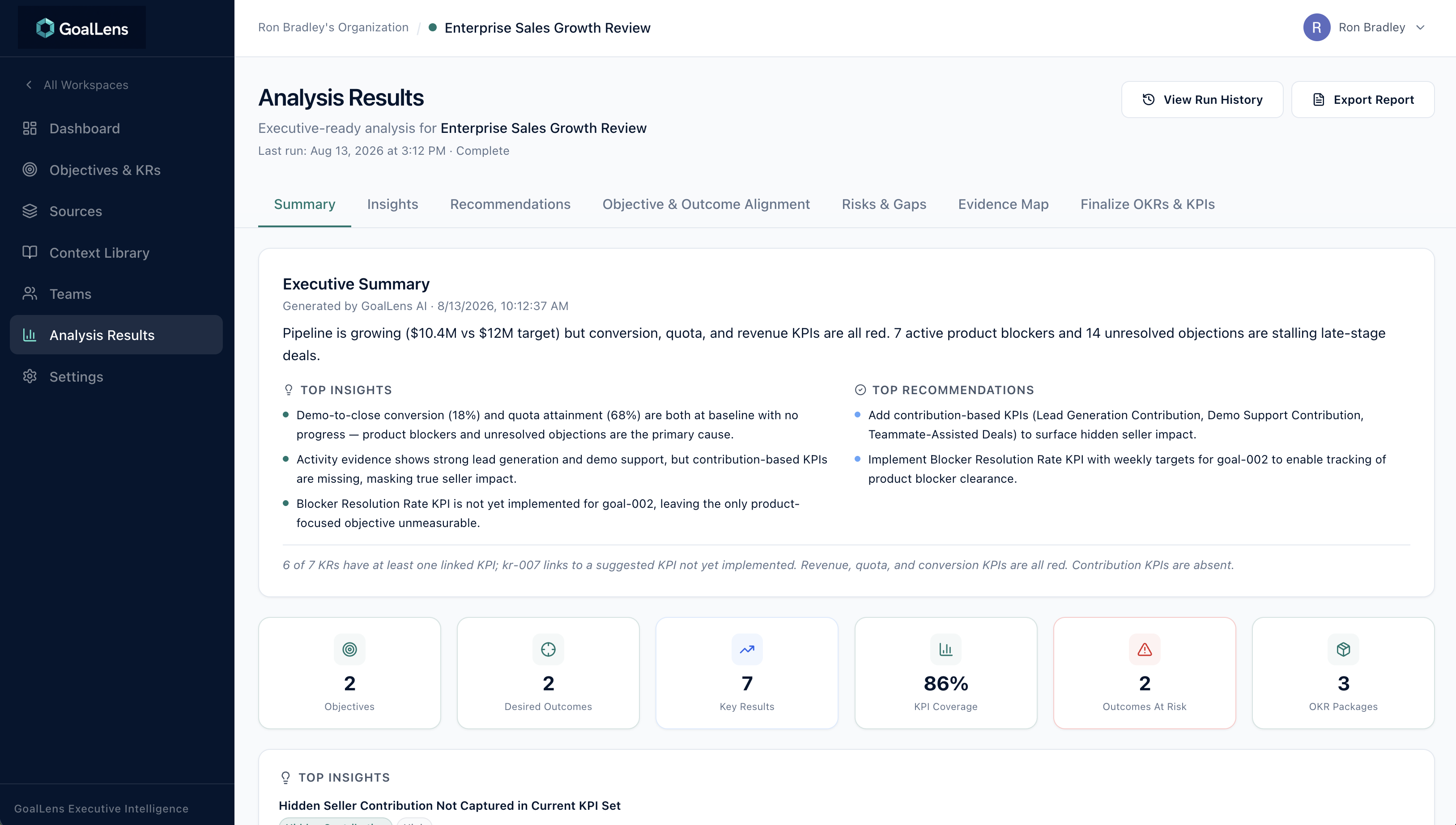
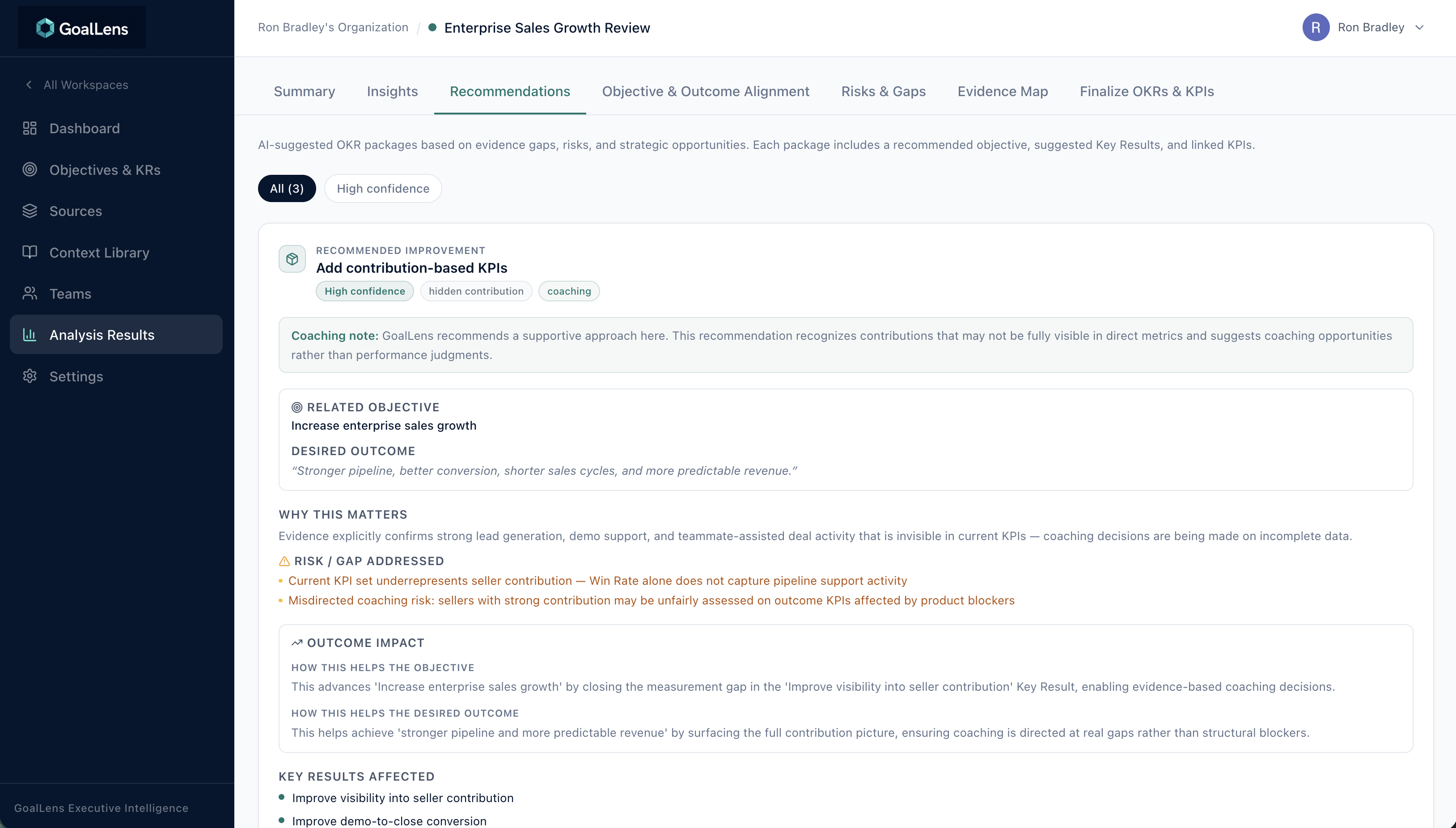
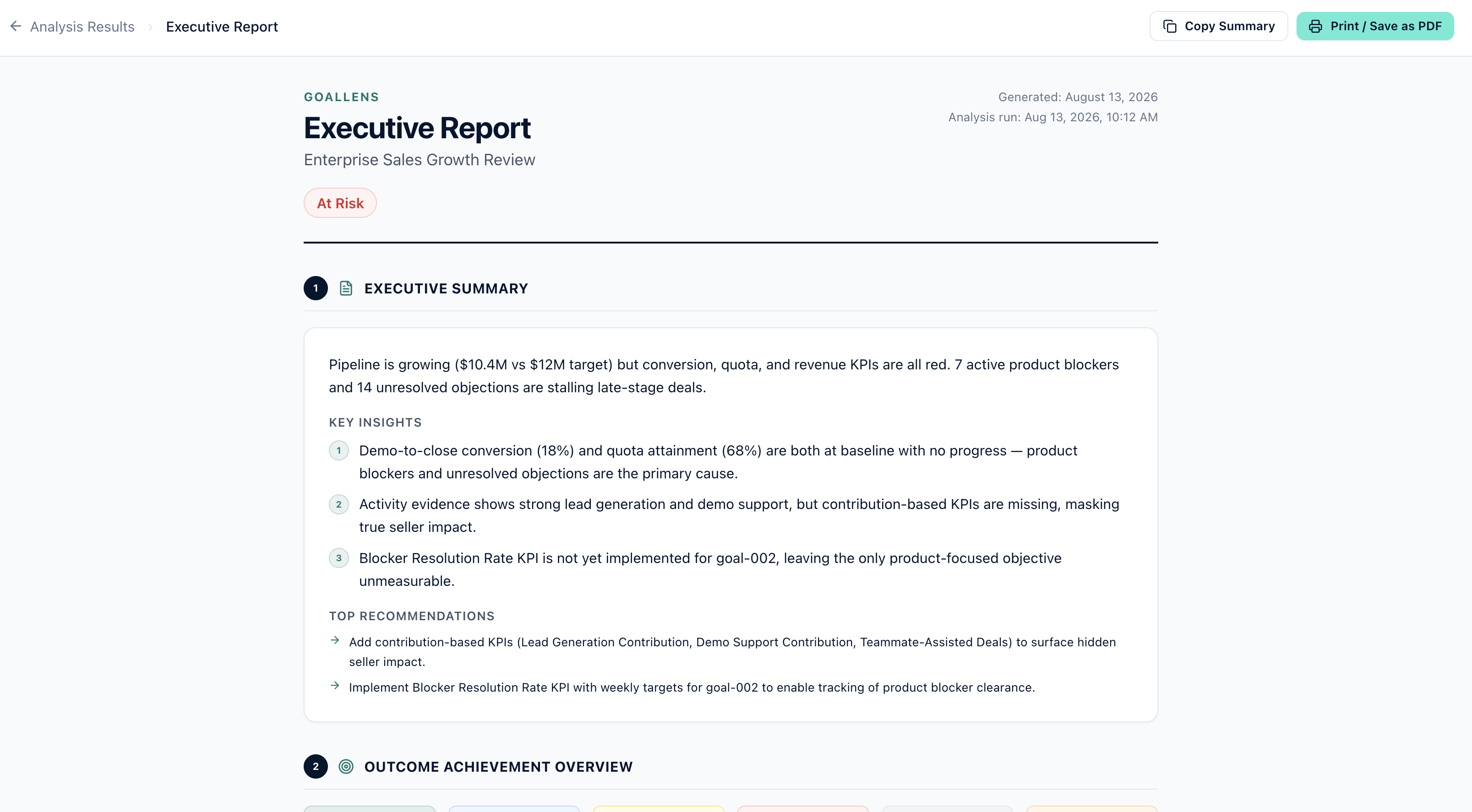
From evidence to a leadership-ready report
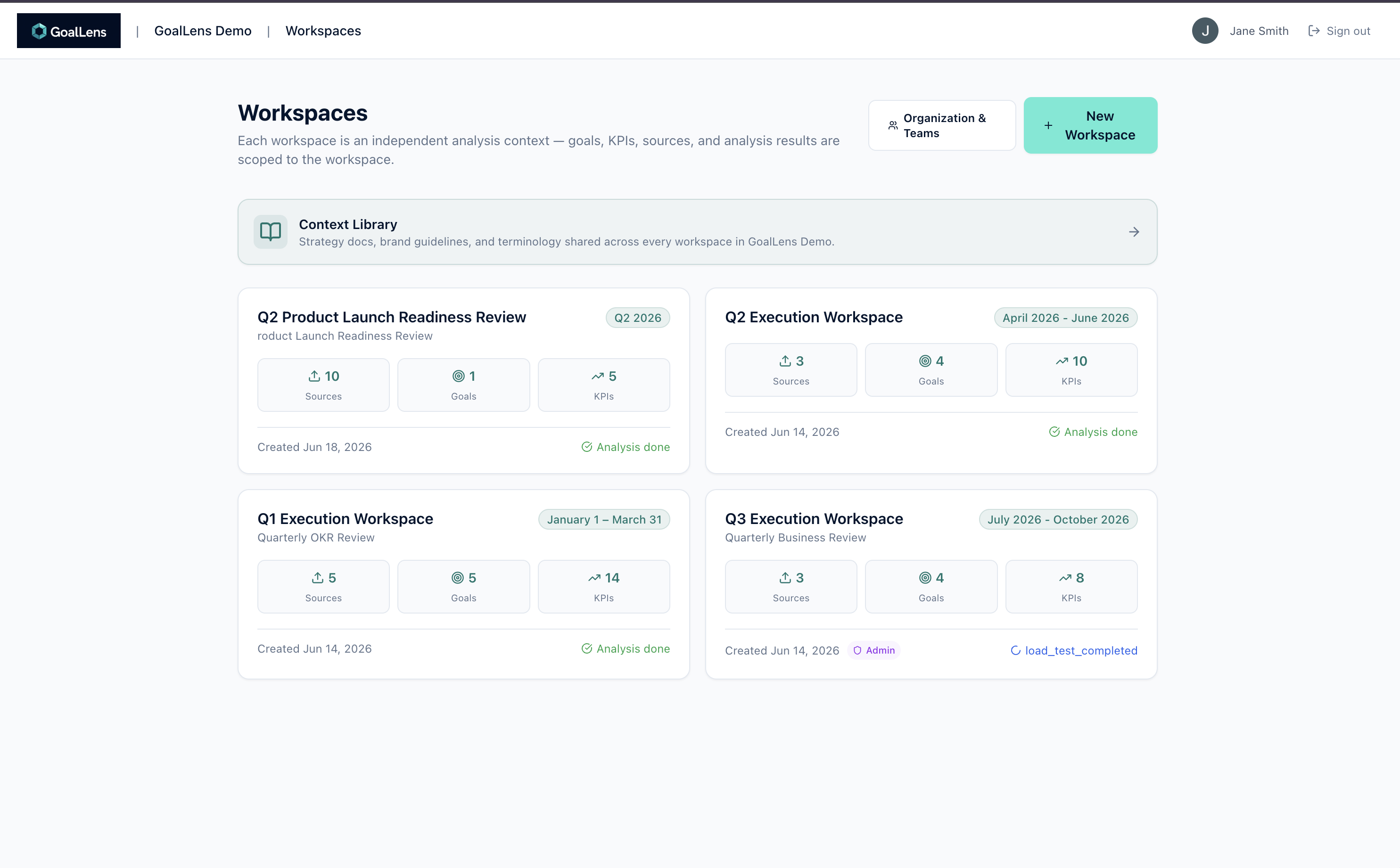
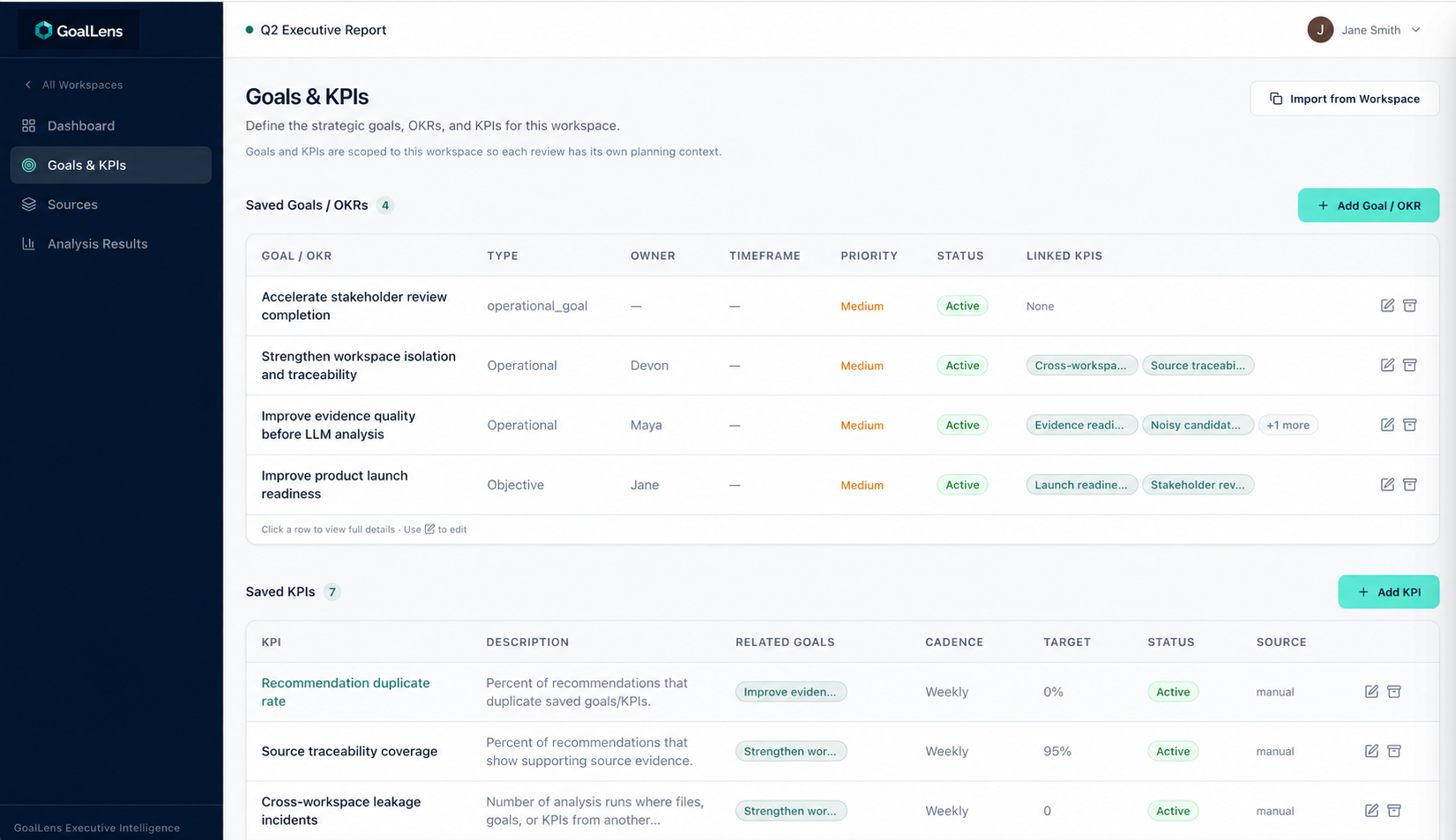
These screenshots show workspaces, governed OKRs after human review, analysis, and the executive report. Connectors and Patterns & Signals live in the product; they are not claimed by these stills.
Grounded AI
Deterministic patterns first. AI-assisted drafts second.
Patterns & Signals extract trends and measurements from authorized sources without a model — they do not generate OKRs. AI-assisted Objective Discovery then proposes a reviewable draft. After governance, analysis runs on a compact Outcome Map plus relevant approved context — not raw files.
Noise out. Signal in.
Strip noise
Remove duplicate, irrelevant, and low-signal content before analysis.
Extract signals
Patterns & Signals deterministically identify KPI movement, blockers, risks, evidence gaps, source freshness, and outcome context. This briefing is not OKR generation.
Build the Outcome Map
Structure evidence around Objectives, Desired Outcomes, Key Results, KPIs, risks, and recommendations.
Add approved context
Bring in relevant, customer-approved organizational context — terminology, strategy, and operating principles — so recommendations reflect how your business actually operates.
Ground recommendations
Generate insights and next actions from evidence-backed signals, not raw document dumping.
Two layers, named: Patterns & Signals are deterministic. Objective Discovery is AI-assisted and proposes a reviewable draft — never auto-approved. Final analysis runs only after humans govern the plan.
Evidence + Approved Context
Evidence shows what is happening.
Approved context shows why it matters.
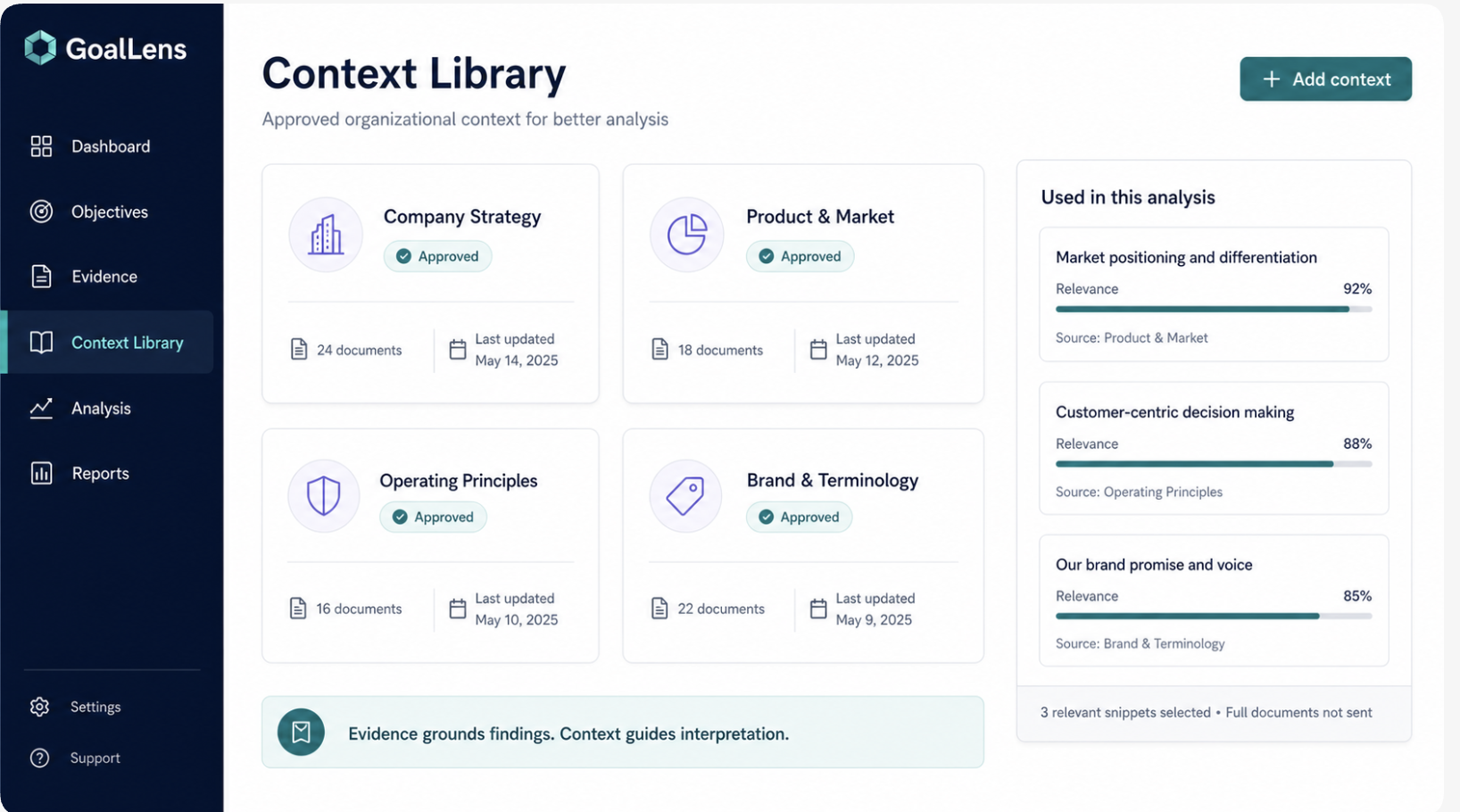
The Outcome Map shows what’s actually happening inside your objectives — the evidence. On its own, evidence doesn’t always carry the context needed to interpret it correctly: a metric can look identical for very different reasons depending on how a team works, what terminology means inside your organization, or what strategic priorities are in play. GoalLens retrieves only the context relevant to an analysis — not the entire Context Library — and combines it with the compact Outcome Map before analysis. Evidence grounds every finding. Context guides interpretation, terminology, and recommendations.
Evidence
Approved context
Combined analysis
GoalLens retrieves only the context relevant to an analysis — not the entire Context Library.
Who GoalLens Is For
Built for RevOps, PMO, Customer Success, and Product leaders
GoalLens connects evidence across Sales, Customer Success, Product, and Implementation into one outcome view. Here's how Jane, VP of Revenue Operations, and her analyst Ron use it: connectors → Patterns & Signals → a reviewable OKR draft → governance → the executive report.
Workspace Setup & Evidence Collection
Ron connects live sources before every leadership review — Jira, Linear, Files, SharePoint, and Google Drive, then reviews Patterns & Signals, runs AI-assisted Objective Discovery, and governs the proposed draft. Once setup is done, GoalLens builds the Outcome Map and hands off a ready-to-review analysis.
- Connect live sources (Jira, Linear, Files, SharePoint — Beta, Google Drive — Beta) and map them to teams.
- Review Patterns & Signals — a deterministic briefing of trends, measurements, blockers, and status.
- Run AI-assisted Objective Discovery; GoalLens proposes a draft; Ron accepts, edits, or rejects.
- Complete governance: desired outcomes, owners, KPI definitions, and approved context.
Cross-Functional Growth Outcome Review
Jane needs to walk into her leadership review knowing whether a critical enterprise growth objective is actually on track. Once Ron's setup is complete, GoalLens shows what is improving, what is at risk, what is missing, and what action to take next. Jane reviews the finished executive report before presenting to leadership.
- Validate whether cross-functional work is supporting the desired outcome.
- Surface risks, evidence gaps, and recommended actions before leadership reviews.
- Walk into leadership reviews with an evidence-backed answer.
- Export an executive-ready outcome report.
Leadership Alignment
Key differentiatorWhen every team reports on their own KPIs, leadership rarely sees whether those metrics are collectively driving the outcomes the company needs. GoalLens shows whether OKRs are backed by real evidence, where measurement gaps exist, and whether the combined execution is supporting the Desired Outcome — not just moving individual metrics.
- See outcome alignment across all Objectives
- Identify OKRs with missing KPIs or weak evidence
- Improve goals before the next planning cycle
Why GoalLens is Different
Not another dashboard. An outcome assurance layer.
OKR tools start from a blank plan. GoalLens starts from connected evidence, a deterministic Patterns & Signals briefing, and an AI-assisted, reviewable draft — not an auto-approved plan. Then it validates whether the objective is actually on track.
Shows whether a KPI hit its target
Validates whether the Desired Outcome is actually on track
Reports on individual metrics in isolation
Traces the full chain: Objective → Outcome → Key Results → KPIs → Evidence
Requires manual analysis to find gaps
Surfaces missing KPIs, weak evidence, and outcome risks automatically
Assumes metric movement equals business impact
Uses execution evidence to verify whether outcomes are actually improving
OKR tools start from a blank plan
GoalLens starts from connected evidence, a deterministic patterns briefing, and an AI-assisted draft you review — never auto-approved
Requires manual interpretation or relies on messy, unstructured context
Strips noise, extracts relevant execution signals, and grounds AI analysis in a structured Outcome Map
Dashboards answer: “What changed in the numbers?”
GoalLens answers: “Is the intended outcome actually on track, what evidence supports it, and what should we do next?”
Why not just use Excel?
Excel can organize KPIs and updates. GoalLens connects those KPIs back to objectives, evidence, risks, and recommendations so leadership can understand whether the intended outcome was actually achieved.
Excel helps organize data.
GoalLens helps interpret cross-functional progress.
Dashboards show metric movement.
GoalLens connects metrics, blockers, evidence, and recommendations back to the outcome.
Slides summarize updates.
GoalLens creates an evidence-backed outcome story leadership can act on.
GoalLens does not replace dashboards or spreadsheets. It helps leadership understand what those numbers are actually delivering.
Dashboards show what moved. Excel organizes data.
GoalLens shows what the objective is actually delivering.
What GoalLens Helps Leadership Understand
What are your objectives actually delivering?
GoalLens helps leadership connect the work happening across teams to the outcomes the business actually cares about — starting from connected evidence, a deterministic patterns briefing, and a reviewable OKR draft.
Is this objective moving revenue?
Connect pipeline, conversion, blockers, customer signals, and execution evidence to understand whether growth initiatives are producing revenue impact.
Are we accelerating delivery?
See whether roadmap progress, implementation readiness, and team execution are helping or slowing the intended outcome.
Are teams aligned around the same result?
Map team-level KPIs, updates, and evidence back to the objective so leadership can see whether cross-functional work is moving in the same direction.
What is putting the outcome at risk?
Surface blockers, gaps, dependencies, missing evidence, and unresolved risks before leadership reviews.
What should we do next?
Turn outcome insights into evidence-backed recommendations that help teams focus on the actions most likely to improve the result.
GoalLens helps leadership see whether objectives are moving revenue, accelerating delivery, reducing risk, and producing the outcomes the business intended.
Privacy & Trust
Privacy and control by design
GoalLens is designed to help teams use AI for outcome analysis without losing control of their business data. Customers decide what to upload, who can access each organization or workspace, what sources should be removed, and what organizational context is approved for use. GoalLens minimizes raw data exposure by extracting relevant outcome signals into a structured Outcome Map, and retrieves only the approved context relevant to each analysis.
Customer-controlled uploads
Customers choose what documents, spreadsheets, reports, and updates to upload. For pilots, teams can start with sanitized files.
Private client organizations
Each customer works in a private GoalLens organization with tenant-aware access controls and separate workspaces.
Role-based access
Admins manage who can view, edit, upload, analyze, and export information.
Access revocation
Admins can remove users from the organization when someone leaves, changes roles, or should no longer have access.
Source deletion
Customers can delete uploaded sources they no longer want used.
Data minimization before AI
GoalLens extracts relevant signals before AI analysis instead of sending full raw document dumps by default.
Private storage
Uploaded sources should be private by default and accessible only through authorized routes.
Audit history
Key actions such as uploads, analysis runs, deletions, invitations, and access changes should be traceable.
Customer-approved context
You choose what goes into your organization's Context Library. GoalLens retrieves only what's relevant to a given analysis.
Outcome Map transparency: GoalLens structures evidence around Objectives, Desired Outcomes, Key Results, KPIs, risks, and recommendations, so users can see how each insight is grounded. GoalLens is designed to use API-based AI providers with privacy-conscious data handling options — as GoalLens moves toward design partners and enterprise pilots, we are prioritizing model-routing, data-retention, and no-training configurations that support customer trust.
Frequently Asked
Do I have to upload sensitive raw documents?
No. For pilots, teams can start with sanitized KPI summaries, CRM exports, roadmap updates, blocker reports, customer feedback summaries, and leadership review decks. GoalLens is designed to extract relevant outcome signals and map them into an Outcome Map before AI analysis.
Does GoalLens just send my files directly to an LLM?
No. GoalLens is designed to parse, clean, filter, and structure evidence first. AI analysis works from a minimized Outcome Map and the relevant, approved organizational context needed to interpret it.
Can we control who sees our data?
Yes. GoalLens uses private organizations, role-based access, admin-managed invitations, and access revocation so customers can control who has access.
Can we remove uploaded sources?
Yes. Customers can delete uploaded sources they no longer want used, keeping them in control of their evidence.
What's the difference between evidence and approved context?
Evidence is the execution data GoalLens extracts from your sources — Files, Jira, Linear, SharePoint — Beta, Google Drive — Beta, and similar — and uses to determine what's actually happening. Approved context is business terminology, strategy, and operating principles your team reviews and approves, used to help interpret evidence correctly and phrase recommendations the way your organization communicates. Context is never treated as evidence — evidence is what grounds every finding.
Does GoalLens send my whole Context Library with every analysis?
No. GoalLens retrieves only the context relevant to the specific analysis being run — not your full library, and not full source documents. This follows the same minimization approach GoalLens uses for evidence.
What sources can I connect today?
Jira, Linear, and Files are available. SharePoint — Beta is app-only Microsoft Graph access to the site, library, or folder you configure. Google Drive — Beta uses a separate OAuth grant: it permits read access to Drive files you can access, and GoalLens ingests only the folder or Shared Drive you configure. HubSpot and Salesforce are coming soon. GoalLens does not write back to any connected system; disconnect is GoalLens-only.
What is the difference between Patterns & Signals and Objective Discovery?
Patterns & Signals are deterministic: they surface trends, measurements, blockers, and status from connected evidence and do not propose OKRs. Objective Discovery is AI-assisted: it proposes a reviewable draft of objectives, key results, and KPIs. Discovered items are never auto-approved — humans accept, edit, or reject them, then add governance before final analysis.
How does SharePoint — Beta access work?
SharePoint is app-only (organization grant), not a signed-in user's mailbox, Teams chat, or personal OneDrive. GoalLens reads only the site, library, or folder scopes you configure and map to a GoalLens team.
How does Google Drive — Beta access work?
Google sign-in is separate from the Drive connector. Connecting Drive uses a distinct OAuth grant that permits read access to Drive files the signed-in user can access. GoalLens limits ingestion to the folder or Shared Drive you configure. It does not write back to Drive. Disconnect is GoalLens-only.
Work directly with us to evaluate your critical objective
We are looking for growth-stage B2B SaaS and tech-enabled teams that want to test GoalLens with a real or sanitized outcome review. Connect evidence from the systems your teams already use — GoalLens will help surface Patterns & Signals, propose a reviewable OKR draft, and show what is improving, what is at risk, and what action to take next.
Use GoalLens to understand whether your Desired Outcomes are being achieved, where Key Results lack KPI coverage, and what the execution evidence actually reveals.
GoalLens grounds AI analysis in a structured Outcome Map and the organizational context your team has approved, so recommendations are tied back to your evidence and expressed the way your organization actually operates.
- We're onboarding a small number of teams directly
- For leaders who need outcome clarity, not just dashboards
- Start with a real or sanitized outcome review
- No spam. We respect your inbox.
Already have a GoalLens account? Sign in.
Sign in with Google, email, or a magic link to continue.
Launch GoalLens